
NEO and Koroyd have been working together to develop safer paragliding products since 2014.
The first tests took two and a half years to find the right combination of Koroyd and foam to meet standards and validate the technology for paragliding. During these tests, we realized that Koroyd technology alone was unsatisfactory and needed to be combined with a special enclosure. So we joined forces with the team from Koroyd to develop a specially shaped foam to meet this need. NEO-KOROYD Technology, tested and registered, was born of this collaboration.
Our common goal has always been to develop protection technology that, throughout the years, has allowed reducing the thickness, weight, and volume of protections while maintaining their shock-absorbing capacity.
Koroyd has been committing to innovation for a safer future since 2010. Their unrelenting search for smarter, safer, and more durable protection solutions is recognized by patented and awarded innovations.
Koroyd and their team operate worldwide. Their headquarters are located at the Monaco Principality and their team is present in the United Kingdom, North America, and China. Koroyd works throughout 5 major commercial units: Sports, Motorsports, Industrial Safety, Family and Defense, and distribute their technology to clients all over the world: from the United States to South Korea.
Thanks to their expertise in various domains, they provide their partners with an in-depth expertise regarding the user’s demands, R&D installations, and setup protocols to offer remarkable protection solutions.
Regarding impact absorption:
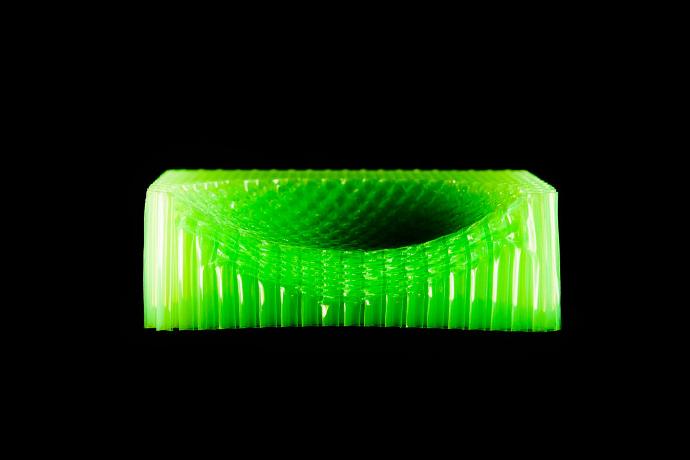
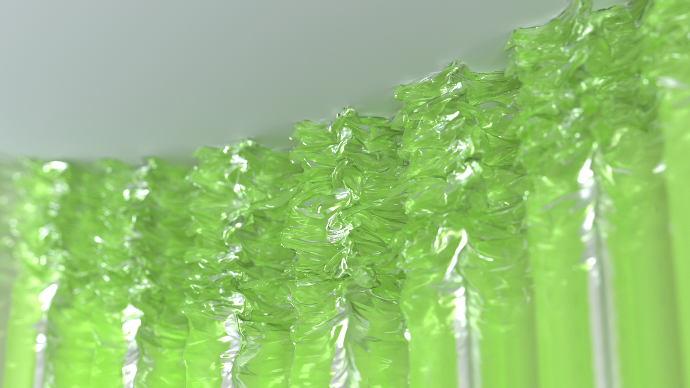
Koroyd technology was developed from an aerospace project following a high-profile air disaster in the UK. The resulting material is an assembly of extruded and thermally welded tubes that crumple instantly and uniformly upon impact, reliably absorbing more force than any other technology.
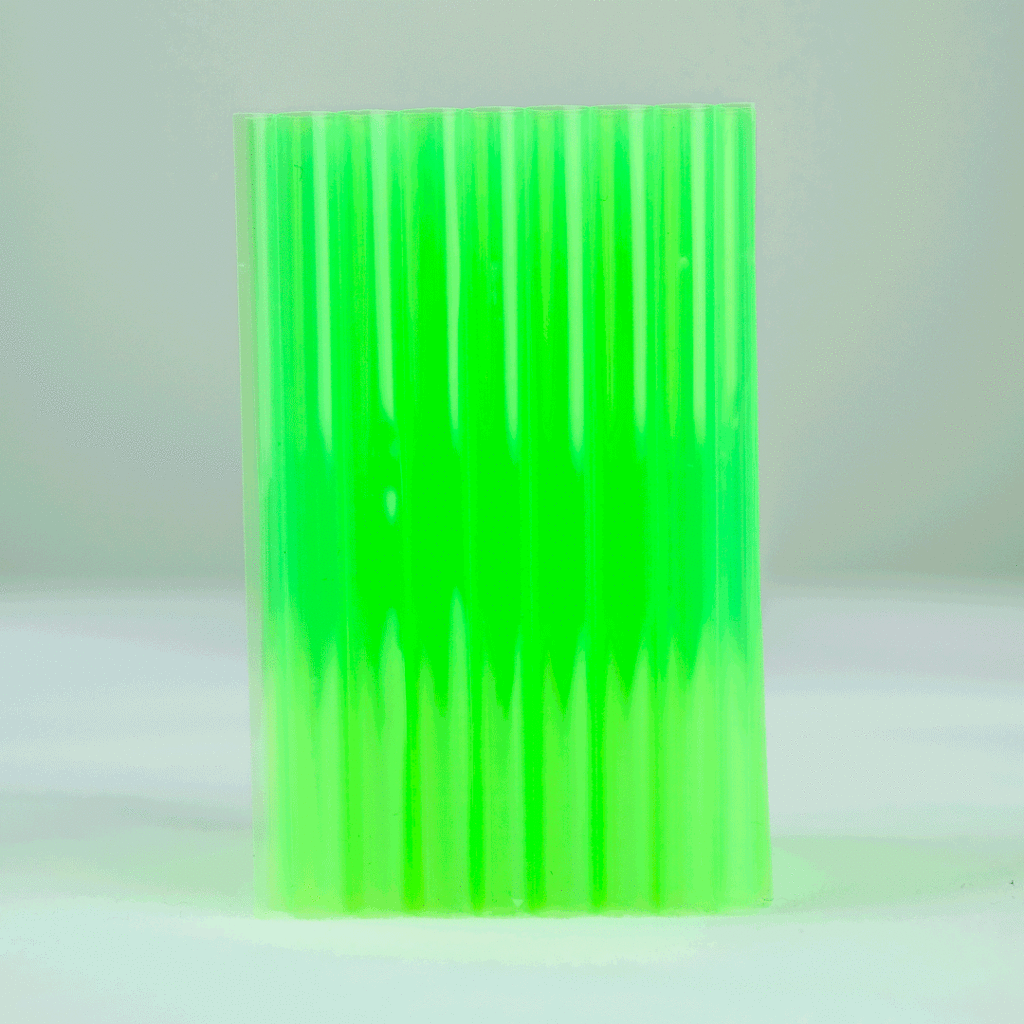
Koroyd is a welded tubular structure incorporated into a variety of products, from action sports helmets and skis to industrial worker protection and child car seats. Koroyd is a welded tubular structure incorporated into a variety of products, from action sports helmets and skis to industrial worker protection and child car seats
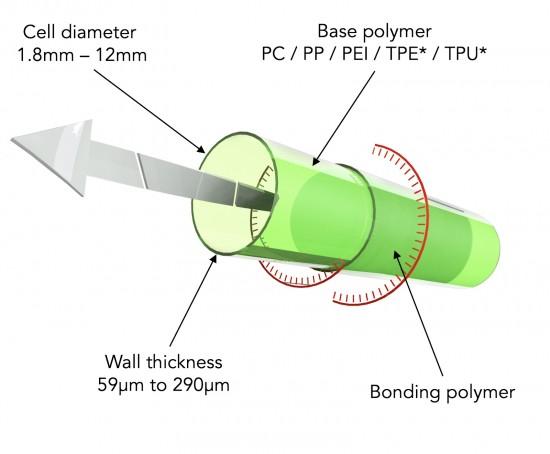
Koroyd’s ordered architecture and the thin walls of the tubes (59μm to 290μm) use a combination of controlled buckling and efficient deformation to densification to achieve high volumetric energy absorption.
The properties of Koroyd material are very close to those of an ideal energy absorber under compression. Koroyd’s mechanical properties are linked to its deformation behavior. Unlike foams (e.g., EPS), Koroyd does not harden during compression; the stress plateau remains completely flat until the material densifies at approximately 70 to 80% compression.
This deformation characteristic is closest to the theoretical model of a mechanical energy absorber.
When the initial compression of an energy-absorbing material is discharged (after an impact), it releases some energy due to its elastic behavior (rebound).
REBOND MINIMAL
Because Koroyd has less elasticity than traditional foam, there is less risk of a second impulse of the energy absorbed during the loading phase (less rebound).
PLASTIC DEFORMATION
With Koroyd, the energy of an impact is converted into plastic deformation, a little heat and a little noise.
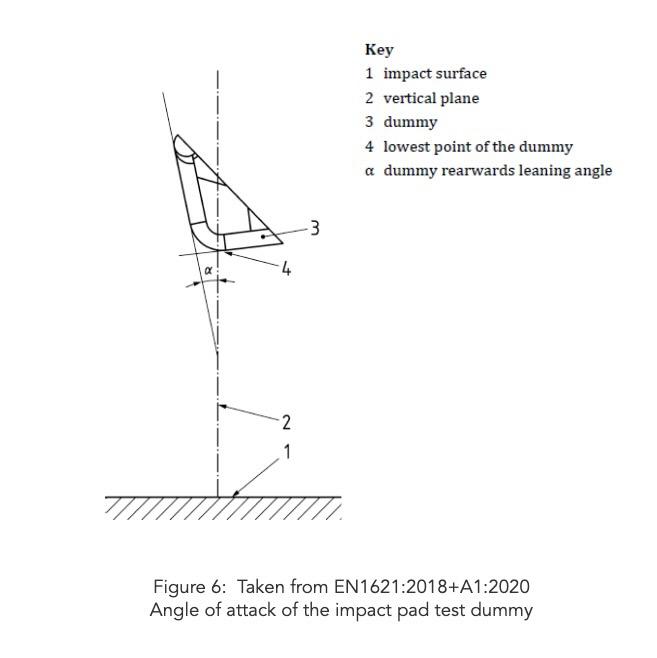
The impact energy associated with the EN1651 standard is 809J with a theoretical impact speed of 5.7m/s (20.5 km/h). The role of the energy-absorbing material is to absorb the maximum amount of energy without densifying and transferring any residual force to the pilot.
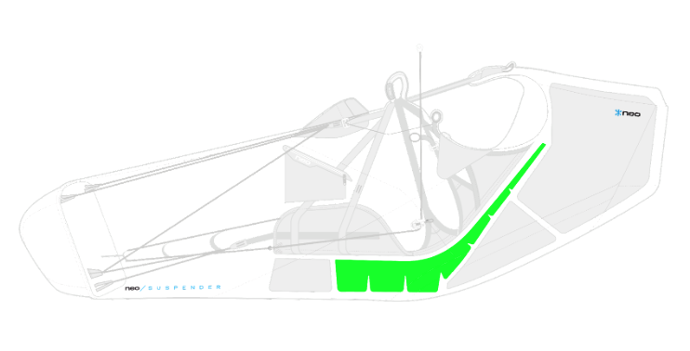
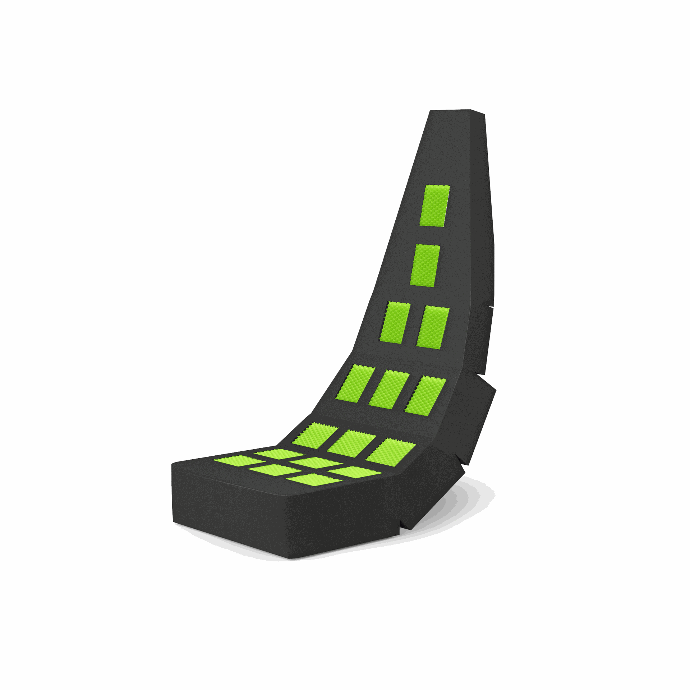
The Koroyd specification chosen for the NEO paragliding application is Koroyd HP60048. This specification has a cell diameter of 6.0mm and a density of 48g/l. Depending on the protection model, the size of the Koroyd inserts varies.
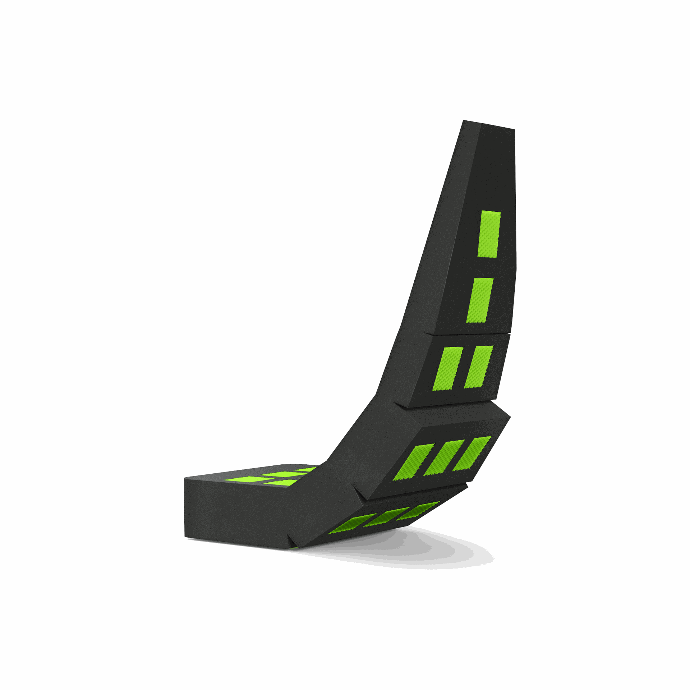
The Koroyd is combined with a 24kg/m³ density foam. The foam provides the overall shape of the protection and holds the Koroyd inserts in place. It also provides a degree of flexibility to the protection.
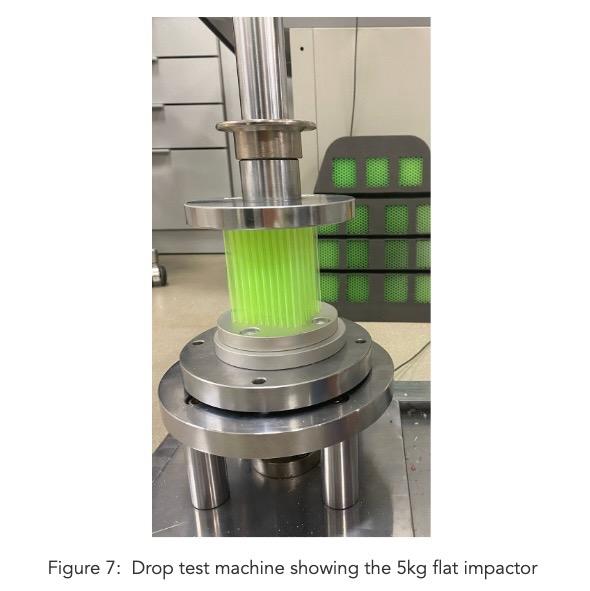
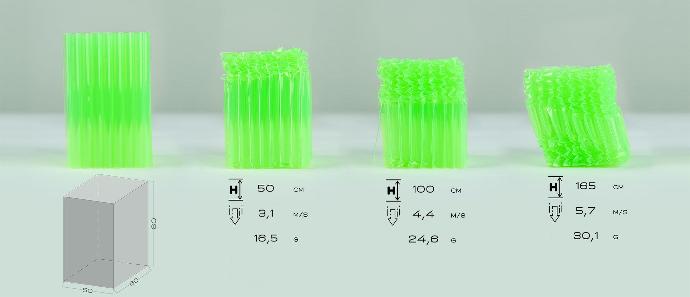
Figure 8 shows the results at low and high impact heights according to the EN1651 test procedure with a 50 kg crash test dummy.
We tested the NEO-Koroyd 3.0 with the NEO Suspender harness at 0.5 m, 1 m, and the standard EN height of 1.65 m in the Air Turquoise laboratory, Villeneuve, Switzerland. The results show effective energy absorption from 50 cm, and therefore for low-speed falls.
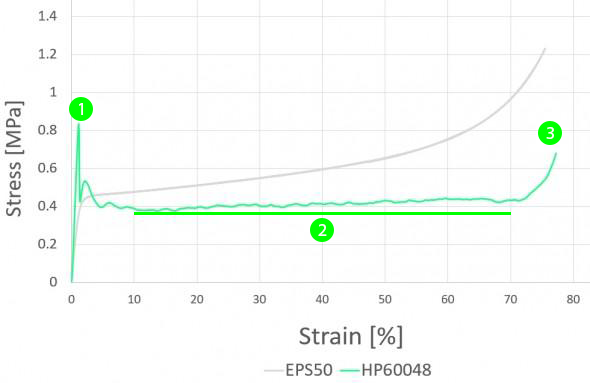
The graph below (Stress/Strain) has been poorly explained or misinterpreted. It is a major point of contention regarding Koroyd in paragliding protection.
This graph was obtained during a laboratory test, the quasi-static test. This is a method used to characterize the damping properties of a material. Unlike a dynamic test where the material is subjected to rapid loads and deformations, the quasi-static test involves the slow and controlled application of a force or deformation to the material. Although this test is not specifically designed to simulate dynamic shocks, it can provide useful information about a material’s response to gradual loads. There is a correlation between the results of the quasi-static test and the material’s performance in absorbing mechanical shock.
Analysis of the stress-strain curve obtained during this test with Koroyd shows:
1 – the ability to absorb a large amount of energy from the very beginning of the impact,
2 – the plastic (irreversible) deformation capacity of Koroyd: this type of deformation helps to absorb energy in a controlled manner during an impact,
3 – the ability to absorb stress using 70 to 80% of its thickness.
These characteristics, demonstrated by the quasi-static test, allowed us to choose Koroyd as a material with real potential for paragliding protection. Koroyd’s performance was validated during low-energy dynamic testing and according to the EN 1651 standard.
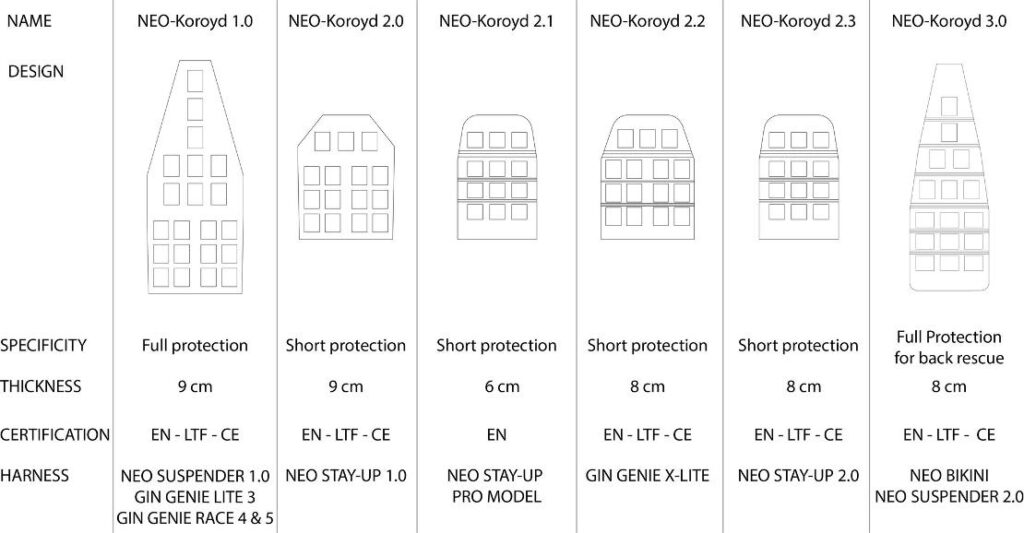
The collaboration between NEO and Koroyd since 2014 to develop safer paragliding equipment has resulted in various types of protection. The table above illustrates the different NEO-KOROYD technologies and their specific characteristics, indicating the harnesses in which they are used.

The technologies developed by NEO and Koroyd have convinced many pilots. Discover the testimonials of some pilots who were protected in a flight incident thanks to the NEO-Koroyd:
“Dear Neo team, I am very grateful to fly with your superb harnesses: the NEO Shorty for three years and the NEO Suspender for two years… as well as with your Hexagon helmet… I am particularly grateful to be able to contact you today because last March, I was involved in a crash for reasons that still elude me. Shortly after takeoff, I found myself on the ground and then in the hospital after undergoing surgery. Today, I can consider myself fortunate that these minor injuries were limited to the bones of my limbs and face, and that there were no spinal injuries, which often lead to significant long-term consequences. The damaged cubes of the Koroyd back protector on my Suspender 1.0, however, suggested that this integrity was not a given. I am sure that the quality of your equipment…” This is one of the main factors that allowed me to recover quickly (regained mobility and no back or head injuries – the Hexagon helmet also did its job)!!!
A huge thank you!!! Keep up the good work and good luck.”
“I did indeed find myself in a tricky situation last August above Hauteluce. I was finishing a beautiful flight when the storm hit. I was caught off guard because it was coming from the Aravis mountains, behind Bisane. So I only saw it at the very end. Unfortunately, it was too late because the rain and turbulence quickly reached me, and I was still high above Lake Girotte. I descended quite quickly to land, and just a few meters from the ground, as I was making my final turn, my wing stalled. I fell a little over 5 meters, slightly inclined to the right. The impact was quite violent; my knee hit my head, my teeth chattered, and I have some muscle pain, but nothing is broken, I’m fine. After all that excitement, I checked my equipment, especially the protection on my Stay-up harness, which really did its job well. A few squares are damaged, and you can clearly see that despite the lateral fall, the protection was very effective.” The squares hit are only partially crushed on one side, and you can easily imagine the direction of the impact.
“Dear NEO, I made a mistake with my Stay-Up harness… I tested the protection in real-world conditions: verdict, it protects very well! 👍 Thank you for this great design!”
“The incident was caused by a failed takeoff and a fall on the front of the takeoff area in Otivar, Spain. No injuries or damage to the harness, but the inserts did their job.”
“Hello, I need to buy some new Koroyd honeycomb cubes for my Gin Genie Lite 3. To be honest, I had a hard fall all the way to the ground, and the NEO Koroyd protection is amazing… it definitely saved my back… I was really pleasantly surprised to see how effective these cubes were in a real accident. Thank you so much for your engineering expertise… Best regards.”
“Flying the challenging cross-country line in the Citusdal Valley (South Africa) above the Winterhoek mountain range, I found the usual downdraft, the one that typically ends in the middle of the valley. I aimed for a sunny field, I remember starting to circle in the thermal, and after a few turns, feeling great… my subsequent memories are all fragmented… I have an image of my paraglider crumpled above me… Then of being on the ground, surrounded by many people, including the rescue team.
I don’t know how long I was unconscious, but my next memory is of two fabulous competition pilots who had landed next to me and were helping me (they were so helpful and reassuring). I remember making a quick initial assessment and judging that I didn’t have any obvious bone injuries (I’m a retired doctor). I was able to walk to the ambulance, but My memories are very vague.
I was later informed that there had been several dust devils in the area… two pilots collapsed violently… one pilot made a rescue maneuver, and another landed with a damaged glider. None of these pilots were injured.
I was taken to the hospital where my head injury was stitched, and I was able to leave the hospital a little later.
Checking my GPS, I realized I had fallen 30 meters vertically.
Thank you, NEO, I escaped this accident unharmed thanks to your system ❤️.